

Stolen credentials are a prime commodity in the Dark Web, often leading to ransomware attacks, one of the most pervasive and damaging forms of cybercrime. In 2023, ransomware attacks surged, with notable groups like LockBit and PLAY leading the charge, indicating a sophisticated and well-organized cybercriminal culture. The financial impact of ransomware is staggering, with costs projected to soar to $265 billion by 2031. The alarming rate at which businesses and organizations fall victim to these attacks underscores the critical need for robust cybersecurity measures.
A single ransomware incident, such as the Clop group’s attack on MOVEit Transfer, can compromise the data of millions, illustrating the devastating scale and precision of these operations. These statistics not only highlight the financial repercussions but also the widespread disruption and potential for significant harm to victims’ lives and livelihoods. It’s imperative to grasp the gravity of the situation and the importance of safeguarding digital assets against such threats.
The dark web provides the infrastructure where stolen credentials are bought, sold, and weaponized. If you're unfamiliar with how the dark web works, read our complete guide to the dark web. In this article, we focus on what happens to your credentials once they enter this underground economy — and what you can do about it.
The Journey of Stolen Credentials in the Dark Web
The journey of stolen credentials is a complex process that begins the moment data is illicitly obtained and ends with its sale on the dark corners of the internet. This underworld economy thrives on the continuous flow of personal information, feeding into various forms of cybercrime.
The Process of Stolen Data Handling

How Credentials Are Stolen
Cybercriminals employ a variety of methods to steal credentials, underlining the importance for companies to adopt a comprehensive security strategy. No single defense can guard against all attack vectors; which is why a layered security approach is essential.
- Phishing: This technique involves tricking individuals into giving away their credentials through the use of deceptive emails or messages that mimic legitimate companies or services. Attackers often create a sense of urgency, prompting victims to click on malicious links or attachments that lead to credential theft.
- Malware: Malicious software can be installed on a user’s device without their knowledge, often through infected email attachments, downloads from compromised websites, or exploiting software vulnerabilities. Once installed, malware can log keystrokes, capture screen information, and steal credentials and other sensitive data stored on the device.
- Data Breaches: When cybercriminals exploit vulnerabilities in a company’s network, they can gain unauthorized access and exfiltrate large volumes of personal data, including usernames, passwords, and other confidential information. These breaches often result from insufficient security measures, such as weak passwords or outdated software.
- Credential Stuffing: Credential Stuffing is an attack that uses previously breached username and password pairs to gain unauthorized access to user accounts on different platforms. Since many people reuse their passwords across multiple services, attackers use automated tools to attempt logins on a wide scale, exploiting the lack of unique passwords.
- Man-in-the-Middle Attacks (MitM): In these attacks, cybercriminals intercept the communication between a user and a service, typically on unsecured or public Wi-Fi networks. By inserting themselves in the conversation, attackers can capture login credentials as they are transmitted, often without either party realizing that the data has been compromised.
The Marketplace for Stolen Credentials
On the Dark Web, stolen information is commoditized and traded with impunity. Credentials and personal data are often sold in combo lists, a compilation of usernames, addresses, ID numbers, passwords, and assorted bits of more information from various breaches.
Each new data breach enriches these combo lists, increasing their value and utility in cybercriminal circles. The anonymity and encrypted nature of Dark Web marketplaces facilitate these transactions, making it challenging for law enforcement to trace and dismantle these networks.
The Uses of Stolen Credentials
Stolen credentials serve as a linchpin for various cybercriminal activities, from credential-stuffing attacks and phishing campaigns to direct account takeovers. These tactics often pave the way for more devastating consequences, such as ransomware attacks on companies. The misuse of stolen information can severely compromise both individual privacy and corporate security, leading to significant financial and reputational damage.
Corporate Espionage and Sabotage
Hackers can deploy advanced persistent threats (APTs) to gain undetected access to a corporate network. This stealthy presence allows them to exfiltrate sensitive data over time without being discovered.
The implications of such breaches are profound, including the loss of intellectual property like patents, the leaking of confidential projects, or the exploitation of sensitive information by competitors or third parties for malicious purposes. These attacks not only threaten the competitive edge of companies but also their operational integrity and stakeholder trust.
Re-Use Stolen Credentials for Further Attacks
Stolen credentials can also fuel further credential-based attacks, phishing efforts, and scam campaigns. When cybercriminals obtain staff credentials, they can use them to install ransomware remotely or trick unsuspecting coworkers into surrendering additional sensitive information. This cycle of compromise can escalate quickly, spreading through an organization and magnifying the potential damage.
Direct Financial Theft
Cybercriminals capitalize on stolen credentials for financial theft, targeting digital wallets and online accounts to siphon funds. The process is alarmingly straightforward yet devastatingly effective, highlighting the need for stringent security measures.
- Bank Accounts and PayPal: Accessing these accounts allows criminals to transfer funds to accounts they control, make unauthorized purchases, or exploit the account’s credit facilities.
- Cryptocurrency Wallets: The anonymous nature of cryptocurrencies makes them especially attractive. Criminals can drain wallets by transferring funds to their digital currency addresses.
- Video Game Library Accounts: These accounts can contain valuable digital items that can be sold for real money or used to make purchases through linked payment methods.
Identity Theft and Fraud
The use of stolen credentials extends beyond immediate financial gain to more insidious forms of exploitation like identity theft and fraud. These acts can have long-lasting impacts on victims’ lives, including legal complications and damage to financial and personal reputations.
- Applying for Credit: Criminals can use stolen identities to open new credit lines, secure loans, or obtain credit cards, often leaving the victim with fraudulent debts.
- Filing for Government Benefits: By assuming an individual’s identity, cybercriminals can divert unemployment, tax refunds, or other government benefits to themselves.
- Renting Properties: Using someone else’s credentials, criminals can rent properties, which may lead to legal issues or damage claims against the victim.
The Price of Stolen Information
The value of stolen information on the dark web varies widely, depending on the type of data and its demand among cybercriminals. For instance, prices can range from as low as $1 for a Social Security number to up to $2,000 for a U.S. passport. Other items, such as credit or debit card details, can fetch anywhere from $5 to $110, depending on additional information provided, like the CVV number or bank details.
Pricing dynamics on the Dark Web: what factors influence the value of stolen credentials
Factors such as the type of data, its demand, the amount of information available, and its potential for misuse all play pivotal roles in setting prices. Below are key elements that influence how stolen credentials are valued on the dark web, reflecting the intricate balance between supply and demand in this underground economy.
- Supply and Demand: The economic principle of supply and demand plays a crucial role in determining prices. Unique or high-demand data can fetch higher prices.
- Type of Data: Specific types of information, like bank account details or medical records, can be more valuable due to their potential for fraud or identity theft.
- Data Freshness: Newly stolen information is typically more valuable than older data, which might have already been used or changed.
- Bulk versus Individual Sales: Data sold in bulk (e.g., lists of credit card information) may be priced lower per item than data sold individually, reflecting the wholesale versus retail pricing model.
- Account Balances and Limits: The value of financial account details can be directly influenced by the account balance or credit limit, with higher balances commanding higher prices.
- Completeness of Information: "Fullz" information, which includes a victim’s full identity details, is more valuable than isolated pieces of data because it enables more comprehensive fraud
Detection and Prevention
Detecting and preventing data breaches are critical steps in safeguarding an organization’s digital assets. Early detection and prevention can significantly mitigate the impact of breaches, with the implementation of biometric systems and increased security budgets being pivotal.
In 2023, global spending on data security reached an estimated $219 billion, stressing the importance of investment in cybersecurity measures, which makes sense knowing that there’s an alarming uptick in breaches that grows every year.
How to detect if your credentials have been compromised
The challenge with stolen credentials is that victims rarely know they’ve been exposed until the damage is done. That’s why proactive detection is critical:
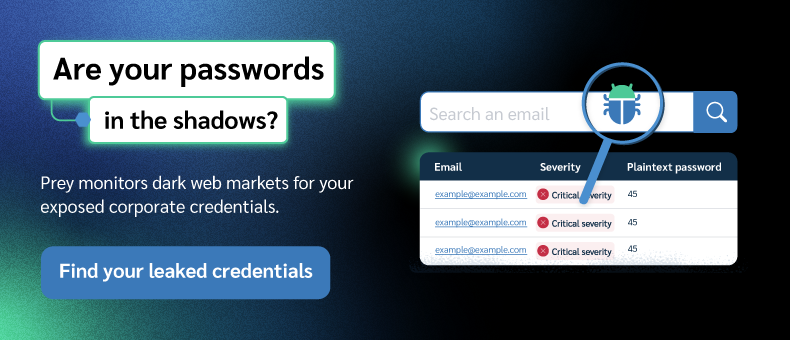
- Dark web monitoring: Specialized tools continuously scan dark web marketplaces, forums, and paste sites for credentials linked to your organization’s domains. When exposed data is found, alerts enable your team to act before attackers can use them.
- Credential breach databases: Services like Have I Been Pwned allow individuals to check if their email or password has appeared in known breaches. For organizations, enterprise-grade solutions provide bulk monitoring across all employee accounts.
- Anomalous login detection: SIEM tools and identity platforms can flag unusual login patterns — logins from unexpected locations, devices, or at unusual hours — which often indicate credential abuse.
- Impossible travel alerts: When the same credential is used from two geographically distant locations within a short timeframe, it’s a strong indicator of compromise.
For organizations that need continuous visibility, Prey Breach Monitoring scans the dark web for leaked credentials tied to your company domains and delivers weekly reports with severity scores, exposed email details, and actionable remediation steps. It’s designed for IT teams that need clear, prioritized alerts — not noise.
Best Practices for Preventing Credential Theft
Preventing credential theft requires a multifaceted approach that combines technology, policy, and education. Key best practices include:
- Using Monitoring Tools: Dark Web Monitoring tools identify compromised credentials, enabling organizations to react before those credentials can be used in further attacks.
- Implementing Two-Factor Authentication (2FA): Adds an extra layer of security, making it harder for cybercriminals to gain unauthorized access even if they have stolen credentials.
- Enforcing Strong Password Policies: Encourages the use of complex passwords and regular changes, reducing the risk of credential theft.
- Promoting Good Digital Hygiene: Educates employees about the dangers of phishing emails, the importance of not reusing passwords, and the need to keep all software up to date.
Frequently asked questions
What are stolen credentials?
Stolen credentials are usernames, passwords, API keys, or authentication tokens that have been obtained by unauthorized parties — typically through phishing, malware, data breaches, or credential stuffing attacks. Once stolen, these credentials are often sold on dark web marketplaces and used for account takeovers, fraud, and corporate espionage.
How do credentials end up on the dark web?
When a company or service suffers a data breach, the stolen data — including login credentials — is often packaged into "combo lists" and sold on dark web forums and marketplaces. Credentials can also be harvested through phishing campaigns, infostealers (malware designed to capture login data), and man-in-the-middle attacks on unsecured networks.
How can I check if my organization’s credentials are compromised?
You can use dark web monitoring tools that scan for credentials associated with your company’s email domains. Prey Breach Monitoring provides weekly reports on exposed credentials, severity scoring, and detailed insights per compromised email address — giving IT teams a clear picture of their organization’s exposure.
What should I do if stolen credentials are found?
Immediately force password resets for all affected accounts. Enable multi-factor authentication (MFA) if not already in place. Review access logs for signs of unauthorized activity. Notify affected users and, depending on your industry, comply with breach notification requirements under GDPR, HIPAA, or other applicable regulations.
How much do stolen credentials cost on the dark web?
Prices vary widely. A single Social Security number can sell for as little as $1, while corporate email credentials with access to financial systems can fetch $100 or more. "Fullz" — complete identity packages including name, SSN, bank details, and credentials — command the highest prices, often exceeding $200 per record.


